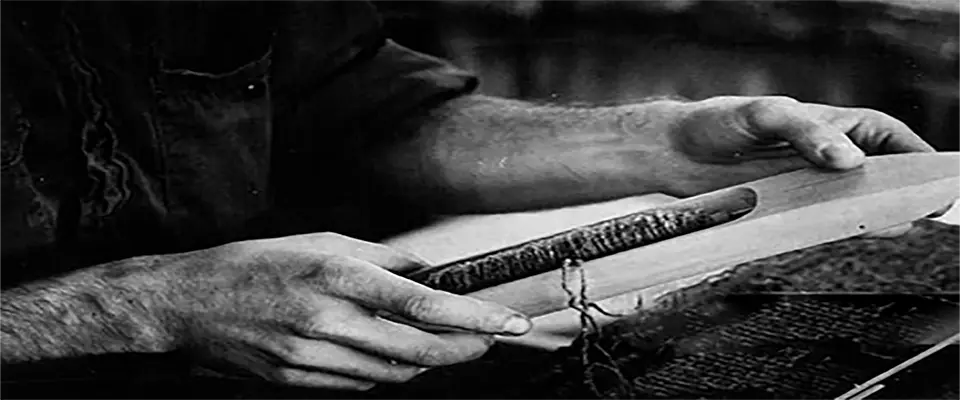
Most businesses speak the language of growth.
Bigger reach. Faster production. Greater scale.
But there are types of work that cannot survive the ambitions of brand building.
There are crafts that require something quieter, slower, and in many ways far more demanding than branding. They require stewardship — the long-term responsibility of carrying knowledge, people, and forward-thinking practices forward without stripping them of meaning in the process.This is not a romantic idea. It is a practical one, and it comes with responsibility and consequences.
Brand building is designed to optimize for visibility, consistency, and expansion. It asks how something can be replicated, scaled, and recognized at a speed the market labels as “successful.”
Stewardship asks a different set of questions.What must not be lost?
What cannot be replaced if it disappears?
What responsibility does the present have to the future?
Branding focuses on growth.
Stewardship focuses on continuity.
Not everything that endures does so because it grew. Some things endure because they were protected — because they carried value beyond branding, particularly within the realities of traditional hand weaving.
Stewardship is not passive preservation. It is active, daily resistance to forces that make work easier, faster, and more profitable — at the cost of depth.
It requires time measured in years and decades, not seasons.
It requires saying no to opportunities that make perfect sense on paper and promise greater visibility.
It requires carrying costs that do not show up cleanly on spreadsheets.
Most of all, it requires accountability to people, not quarterly outcomes.When knowledge lives in hands, muscle memory, and lived repetition, it cannot be rushed, outsourced, or automated without damage. Mastery transfers only inside the conditions where the knowledge lives — through time and patience, not instruction manuals.Once that chain is broken, it does not restart easily, if at all.
Modern business models assume that if something is successful, it must be scaled. That assumption collapses when applied to knowledge that exists only within bodies, relationships, and place.
When craft is separated from the conditions that created it — the pace, the environment, the transmission between generations — it does not evolve. It degrades.Efficiency, in this context, is not neutral. It actively erodes the very qualities that made the work worth preserving.
This is why stewardship often appears inefficient from the outside. The metrics used to evaluate it are simply wrong — particularly when applied to the remaining master weavers who carry this knowledge today.
Stewardship rarely looks impressive in the short term. It favours small ecosystems over rapid expansion. It prioritizes integrity over uniformity. It accepts limitation as a form of protection.
The cost is real: slower growth, higher effort, fewer shortcuts. But the alternative is worse — work that survives in name only, emptied of its intelligence and purpose.
What stewardship protects is not nostalgia. It protects continuity — the ability for something real, and currently endangered, to exist tomorrow, not just today.
The pressure to turn everything into a brand has never been greater. Speed is rewarded. Uniformity is mistaken for quality. Visibility is treated as proof of value.In that environment, stewardship is easily misunderstood — or dismissed entirely.
But stewardship is not an abstract idea at Jennifer’s Hamam and Jennifer’s Collection. It is a practical response to a shrinking reality.
We do not work with a small number of master weavers by choice. We work with the number that still exists in Türkiye. That number is getting smaller every year, and without intervention it will continue to decline.
Until there is the space, permission, and infrastructure to teach — until the conditions exist to rebuild a population of weavers rather than simply rely on those who remain — stewardship means holding the work intact during a pause.
It means refusing to dilute the craft in order to compensate for scarcity. It means not replacing people with systems and machines simply to keep production moving. It means protecting the knowledge that still exists long enough for it to be passed on.
This is how we operate today — not because this is the ideal state, but because it is the responsible one.That position is slower. It is more demanding. And it does not scale in the way modern business models expect.
But stewardship, in this context, is not about growth for its own sake. It is about continuity — about ensuring that what exists today still exists, meaningfully, tomorrow.And that responsibility is not something we market.
It is something we carry.
Jennifer's Hamam
125 Arasta Bazaar
&
Ogul Sok. NO: 20
Jennifer's Collection
135 Arasta Bazaar
Sultanahmet, Fatih, Istanbul
Türkiye
January - February
8:30am - 8:00pm
Istanbul time
March-December
8:30am - 10:00pm
Istanbul time