
 Get in touch with us
If you have ever tried to buy a genuinely hand-woven Turkish towel, you have probably asked this question: how do I actually know I am getting the authentic thing?
It is a fair question. And one worth answering honestly.
The thick-looped Turkish towel was invented by Ottoman weavers in the 17th century. That single innovation, creating loops on the surface of a flat-woven cloth to make it soft, plush and deeply absorbent, earned Türkiye a reputation that travelled the world. People still reach for "the Famous Turkish Towels" with a sense of quality in mind. The name carries real weight, and rightly so.
What most people do not know is how little of that reputation now reflects the reality behind it. The invention itself barely spread beyond the borders of what is today Türkiye before mechanization arrived and made the question of spreading it almost irrelevant. Industrialization moved faster than tradition. And as the machines took over, the name "Turkish towel" travelled on without the technique that had made it famous.
Today, a towel carrying a label that says "Made in Turkey" leads the consumer to believe they are purchasing a Famous Turkish Towel. The label confirms geography. It confirms nothing about the method, the quality, or the tradition behind the cloth.
After 17 years of working directly with the last remaining traditional weavers in Türkiye, my honest answer to the question of how you actually know is this: it has become almost impossible for any consumer to tell for certain. Not because the real thing does not exist. It does, and we make it. But because the markers that once distinguished hand-woven from machine-made have been eroded, copied, and misunderstood over time.
This article is my attempt to tell you the truth about all of them.
Most people start with the label. So let us start there too.
"Made in Turkey" tells you where the towel was manufactured. It does not tell you how. A factory running hundreds of automated machines, producing thousands of towels a week, can truthfully print "Made in Turkey" on every single one. So can we. The label is not a lie. It is simply not the information you actually need.
"Turkish cotton" tells you something different, but equally incomplete. It refers to a specific variety of long-staple cotton grown primarily in Türkiye's Aegean region. It is genuinely excellent fibre. But a factory anywhere in the world can import Turkish cotton fibre, feed it into automated machines, and truthfully print "made with 100% Turkish cotton" on the hangtag. The cotton's origin and the towel's manufacturing method are two entirely separate things.
"Turkish cotton" tells you something about the fibre. It tells you nothing about the hands, or the machines, that turned it into a towel.
And while we are here: "Turkish cotton" and "GOTS certified organic Turkish cotton" are not the same thing. Organic certification means the cotton was grown without synthetic pesticides or chemicals and processed under strict standards from field to finished thread. Organically processed cotton is significantly more absorbent, releases moisture faster, and does not go hard over time or develop that musty smell common in towels made with non-organic cotton. It also lasts considerably longer, because no chemical residue has been worked into the fibres during processing. Those residual chemicals, invisible to the eye, continue breaking down the thread from within long after the towel has left the factory, and through daily use, they are absorbed by the skin of the person using it.
The emails that arrive most mornings are the ones that keep us going. Long-term clients writing to say their towels from five, ten, fifteen years ago are still going strong. Clients who come back every year just to see what is new. People who confess their linen closets are overflowing because they cannot stop. These are not towels ending up in landfill after two years. They are towels being loved and treasured.
You can read more about our threads and why the choices we make matter [Our Threads page].
For decades, hand-tied tassels were considered a reliable sign of hand-woven quality. The logic made sense. If someone took the time to knot each fringe by hand, the towel was probably made by hand too.

That logic no longer holds.
Today, small factory producers making thick-looped towels at scale also finish their pieces with real tassels, properly knotted, indistinguishable in appearance from those on a genuinely hand-woven piece. The tassels are not fake. They are simply no longer exclusive to the handmade world. And the towel they are attached to has nothing in common, structurally, with one made on a traditional shuttle loom.
Before anyone reads this as a case against tassels, let me be clear about where I stand.
When clients ask us to remove the tassels from our towels, this is what I tell them: "It is my belief that tassels are in our DNA. I am happy to cut them off if you insist, but I recommend leaving them on. They are part of the beauty of a handmade towel and will not give you any grief if you ensure that you never wash them with buttons, zippers, velcro, or items with straps. They grow on you, and after three months you will look at your factory-seamed towels and wonder how you ever thought they looked normal." And I always leave the decision to them.
Tassels are worth keeping. They are just no longer worth using as evidence of how a towel was made.

This is a small detour, but an important one.
Most people associate the word "loom" with handcraft. A weaver at a loom, working by hand. And for thousands of years, that association was accurate.
Today, the word "loom" by itself tells you nothing.
The same word also describes enormous automated machines that produce fabric at extraordinary speed with minimal human involvement. The machines that make the vast majority of towels sold as "Turkish" worldwide are also called looms. They are entirely mechanical. One person can monitor dozens of them at a time, moving along the aisles, pressing stop when something needs attention, restarting, moving on.
What matters is whether a shuttle loom is involved, because a shuttle loom creates a fundamentally different structure in a thick-looped towel than any mechanised machine is capable of producing. The shuttle carries a continuous thread that loops back on itself at every edge, building the fabric pass by pass in a way that cannot be replicated by a machine that simply cuts the thread and moves on. The word "loom" sometimes appears in marketing materials for factory-made textiles and sounds reassuring. The word "shuttle loom" is the one that actually matters.
Now to the detail that still matters most, at least for thick-looped towels.
On a traditional shuttle loom, the weft thread, the one that travels horizontally across the fabric, does not simply pass through and stop. It loops back on itself at each edge, completing the return journey with every single pass. This continuous, unbroken action creates what is called a selvage edge: a self-finished border with no raw ends, no stitching, no overlocking. Just a clean, dense, naturally sealed edge that is structurally part of the fabric itself.
You can see it in the photograph below. That cream-coloured band running alongside the green loops of the towel. No stitching. No thread ends. Just the fabric, completing itself.
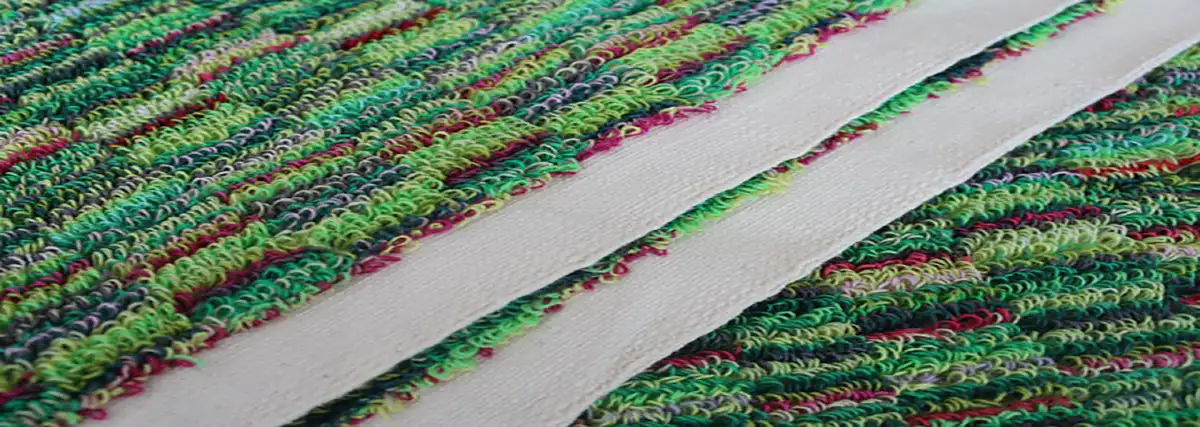
Automated factory machines work entirely differently. Rather than a single continuous thread looping back on itself, these machines carry the weft thread across the fabric mechanically and then cut it at the edge. By design, not by accident. There is no loop-back, no self-finish. The edge must be sewn or overlocked because the structure that would create a natural border was never there to begin with.
For thick-looped towels, the selvage edge remains the most reliable physical indicator that you are holding something genuinely hand-woven.
But, and this is the honest part, even we have our limits here.
Our looms come in fixed widths. When we use our larger loom to weave narrower towels, we set up multiple pieces side by side across the full width. When the weaving is finished, those pieces must be cut apart. The pieces at the outer edges retain a true selvage on their outer side. Every cut edge, and every inner piece, ends up with raw edges that need finishing. So we sew them.

In the early years, I tried leaving the true selvage on one side and sewing only the cut edge on the other. I thought clients would value the proof. What happened instead was that people hesitated, noticing the two sides looked different. When that came up, I would offer to have the other side seamed to match. After a year of that, I gave up and now we finish both sides consistently on the narrower sizes.
Currently, two sizes show a true, unstitched selvage edge on both sides: our 95 x 180cm towel, woven as a single piece on one of our smaller looms, and our 185 x 245cm blankets, woven one piece at a time on our larger looms. Our smaller looms also produced our 50 x 100cm hand towels with selvage edges on both sides, but those looms did not survive the move from Mardin to Uşak intact and are still under repair - read "The Move That Saved a Tradition". On every other size, the weaving itself is genuine, but the edges have been finished for the sake of consistency.
I tell you this not to undermine the value of what we make. I tell you this because it is true, and because you deserve to know.
This is where things get even more complicated, and where a common misunderstanding needs to be addressed first.
Pestamel (pronounced pesh-ta-mel) are flat-woven textiles. Unlike thick-looped towels, they have no raised loops on the surface. They are lightweight, smooth and versatile, and they have been part of the Turkish hamam tradition for centuries. In recent years, the term "Turkish towel" has been applied so broadly that many people now use it to describe pestamel, flat-woven pieces and thick-looped towels interchangeably. They are not the same thing. The looping technique that made Turkish towels famous worldwide was a specific invention, applied to a specific structure. Flattening that distinction does a disservice to both.
For pestamel, the question of proof is even more difficult.
There was a time when a selvage edge on a pestamel was definitive proof of hand-weaving. That time has passed. Small factory machines producing pestamel at scale now use mechanisms that create what looks, from the outside, like a genuine selvage edge. It is a structural imitation, produced mechanically, but convincing enough that the naked eye cannot easily tell it from the real thing.
What was once our clearest proof has been copied.
If the "Made in Turkey" label proves nothing about the method, if "Turkish cotton" reveals nothing about how the towel was woven, if tassels are no longer exclusive to the handmade world, and if even the selvage edge has limitations for thick-looped towels and has been replicated for pestamel, what remains?
Provenance. Transparency. The ability to trace a textile back to specific workshops, specific looms, a specific place.
A factory produces volume. It does not produce stories, because stories were never part of the process. What you can trust is an operation honest enough, and small enough, to tell you exactly where every piece was made and how.
I oversee the purchase of every thread that goes into our work. I know what goes into every piece, from first metre to last. I work directly with the master weavers who run our workshops. I know how many looms we have and what is running on each one.
I want to put that in perspective with one moment that has stayed with me since 2009. When I finally tracked down the last weaver in Türkiye still producing genuine thick-looped towels on a traditional shuttle loom, he was ten days away from his second bankruptcy. He already had an appointment scheduled to sell his looms to the scrapyard. That is how close this craft came to disappearing entirely, not decades ago, not in some distant chapter of history, but serendipitously the year I opened Jennifer's Hamam.
No machine, no matter how advanced, has replicated what those looms produce. Not even close. That is not sentiment. It is simply the reality of what hand-weaving on a traditional shuttle loom creates: a structure, a density, a character that automated production has never been able to copy.
That level of fragility, and that level of transparency about it, is itself a form of proof.
You cannot replicate a story you never lived.
This article has probably not given you the simple checklist you were looking for. I understand that, and I am not entirely sorry about it, because a simple checklist would not have been honest.
The markers of authenticity in hand-woven Turkish textiles have been eroded, copied, and misunderstood over time by an industry very good at copying surfaces while ignoring everything underneath. What you are really looking for, what all of this comes down to, is not a tassel or a label or an edge. It is a source you can trust completely.
We have been that source since 2009. And we still are.
Jennifer's Hamam is located at 125 Arasta Bazaar, Sultanahmet, Istanbul. We ship worldwide and offer virtual tours for international clients. If you would like to see the selvage edge of our 95 x 180cm towel for yourself, come and find us.
Further reading: Hand-Woven vs Machine-Made: What You Should Know About Turkish Towels | The Threads That Set Us Apart | The Move That Saved a Tradition | Why Choosing an Ethical Towel Makes a Difference