
 Get in touch with us
Most people who care about the environment feel the same quiet frustration. You recycle. You bring your own bags. You try to buy less. And yet the scale of what needs to change feels so vast that individual choices can seem almost pointless.
They are not pointless. But they have to be real choices, not just better-looking versions of the same problem.
This is about one of those real choices, and why a towel, of all things, is worth thinking about carefully, especially when you understand how weaving works, from warp and weft to finished cloth.
For those already searching for eco-friendly or sustainable towels, the question is not just what the label says, but how the textile is actually made.
Most towels sold today, at any price point, are made from conventionally grown cotton. Heavy irrigation. Pesticides. Synthetic fertilisers. The cotton is picked by hand, by people working in those fields, exposed to chemicals that affect their health, the soil, and the water around them.
That raw cotton is then heavily processed to strip the natural lint and force the towel to perform immediately. It works, briefly. But in doing so, the cotton is fundamentally altered. It becomes less absorbent over time, not more. It retains moisture instead of releasing it. It hardens, develops that familiar musty smell, and breaks down faster than it should. Those processing chemicals do not simply disappear. They are absorbed, wash after wash, by the skin of the people using the towel.
Within a few years, the towel is threadbare and no longer enjoyable. It is tossed away and another is purchased. The cycle continues.
This is true whether the factory towel costs twenty dollars or two hundred. The material and the process determine the outcome, not the price tag.
Organic Turkish cotton, genuinely certified and grown without synthetic pesticides or forced irrigation, can use up to 91% less water than conventional cotton, based on life cycle assessment data from the organic cotton sector. The land stays healthier. The water table is not contaminated. The people picking the cotton by hand are no longer being exposed to chemicals that harm their health.
During processing, nothing is done to force the cotton's performance. It is left to behave as cotton behaves when it is grown and handled with integrity. Which means it gets better over time, not worse. The weave opens with washing. The absorbency deepens. The softness arrives and stays.
Jennifer personally sources every thread used across Jennifer’s Hamam and Jennifer’s Collection, travelling to suppliers and inspecting quality at the source. This is not delegated. It is the foundation of everything that follows.
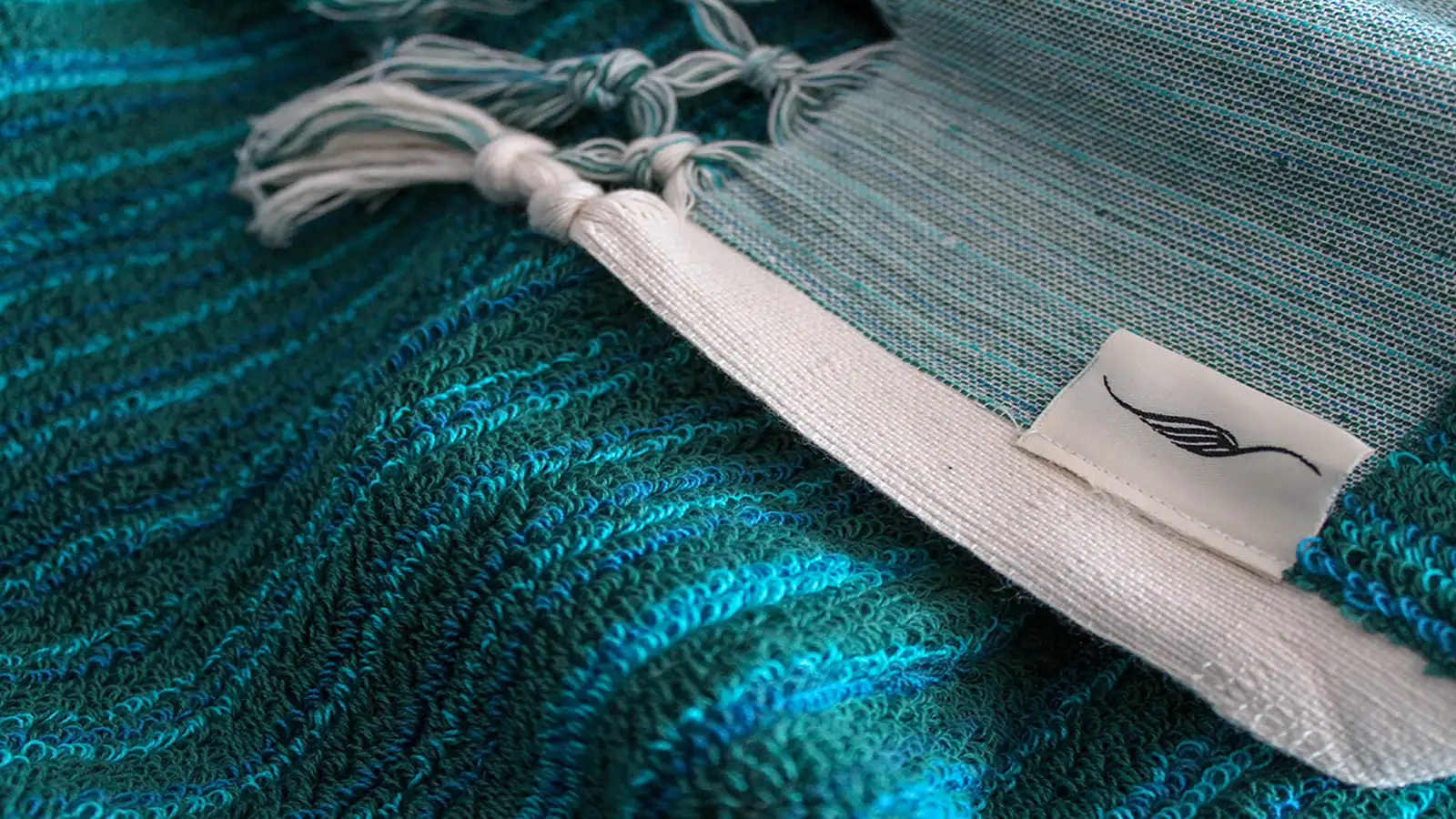
In the 17th century, Ottoman weavers invented the thick-looped towel on traditional shuttle looms. The loop structure is woven directly into the textile, not applied to its surface, and it is this structure that gives the towel its absorbency, its softness, and its extraordinary durability.
A factory machine can copy the appearance of that structure. It cannot copy the structure itself. That difference lives in every thread.
Jennifer's Hamam is the only company in the world still producing thick-looped Turkish towels on traditional shuttle looms. Not the only company in Türkiye. The only company in the world.
Which means that if a thick-looped Turkish towel woven the way it was originally designed to be made is what you are looking for, there is only one place to find it.
Every piece is made by master artisans who have spent their lives at these looms, woven by human hands that have developed a sensitivity to tension, rhythm, and material that no machine has ever matched. There is something in an object made by human hands that is felt before it is understood.
This is the same method used in every handwoven towel in Jennifer’s Hamam and Jennifer’s Collection, where the structure is built into the textile rather than applied afterward.
These textiles do not arrive at their best. They become their best. They settle and improve with every wash rather than declining. One client returned to Jennifer's Hamam after ten years and wrote simply: "Ten years later they are still lovely and are our favourite towels." (TripAdvisor review, December 2025)

Jennifer acquired, at considerable personal expense, a towel woven on a traditional shuttle loom by a woman's great-grandmother. When Jennifer purchased it, it was already at least 100 years old, and likely older. For the previous decade it had been used to wipe down restaurant tables, bleached repeatedly, and treated with harsh cleaning chemicals.
There is not a single hole in it.
Running along its edges are decorative stripes woven in silk, still present, still holding their colour after more than a century of use. The people who made that towel understood their materials so completely that they chose to weave silk into a bath towel, knowing it would survive.
The cotton has hardened from the bleaching. What vinegar and care would have preserved, chemicals took. But the structure is intact. The loops are still there. The weave has not given way.
No factory towel made in the last hundred years still exists. This one does. This is what longevity actually looks like:

Jennifer’s Hamam and Jennifer’s Collection textiles are not the most expensive towels on the market. There are factory-made products priced higher that will not survive a fraction as long.
If a factory towel needs replacing every three to five years, and a handwoven towel lasts fifteen or more, you are no longer spending funds that feed a cycle of waste. You are investing in something that becomes part of your life.
In those fifteen years, four or five factory towels have not gone to landfill. Four or five cycles of chemical farming have not taken place. And one master weaver in a village in Türkiye has continued his craft rather than being forced toward factory work in the city. Weaving is physically demanding, relentless, skilled work. Jennifer pays her weavers per piece, at rates that amount to three times or more than what is considered a fair wage in Türkiye, because that is what the work deserves. Most artisans, even at so-called fair trade wages, barely make a living.
One client, who had just completed a Master's thesis on conscious consumerism and the global sustainability agenda in the textile industry, wrote after visiting: "Jennifer's has single-handedly endeavoured to keep alive an art that is vibrant, skillful, and breathtaking." (TripAdvisor review, Jennifer's Hamam)
Most people who make this choice for the first time expect to feel good about the ethics. They do not expect to fall in love with the towel.
But they do.
Because a handwoven textile made from organic cotton, woven by human hands on a traditional shuttle loom, is not just the right choice. It is the best towel most people will ever own. It improves with every wash. It becomes something reached for without thinking.
"I've never experienced anything similar to the touch and feel of these marvellous towels." (TripAdvisor review, Jennifer's Hamam)
"I never thought I could be so excited about a towel." (TripAdvisor review, Jennifer's Hamam)
Doing the right thing and having something extraordinary turn out, in this case, to be exactly the same decision.
You cannot fix the textile industry alone. Nobody can.
But you can invest, once, in something made properly. From cotton grown in a way that supports the land and the people who tend it. By hands paid what they deserve. On looms that have been running for generations. Built to last long enough that you never have to think about it again.
Save the planet a little. Save an art that is almost gone. Support an artisan who deserves it. And end up with the best towel you have ever owned.
That is not a compromise. That is the whole point.
If you are curious what this feels like in real life, the easiest way to understand it is to see the textiles themselves.
We offer private virtual tours where our team walks you through the textiles, explains the materials, and helps you choose pieces that suit your home and lifestyle. Appointments are available daily, and the process is simple from anywhere in the world.
You can also explore the collections directly:
[Handwoven Turkish Towels] [Pestamel and Peskir]
And if you are looking for something rarer still, conceived with a more singular vision, produced in smaller quantities, or made entirely to your specification, Jennifer’s Collection is where that begins. Bespoke requests are welcome.
[Discover Jennifer’s Collection]