
 Get in touch with us
Weaving is a textile-making technique in which two sets of threads, the warp and the weft, are interlaced to create fabric. The vertical threads are called the warp, and the horizontal threads that pass across them are called the weft.
When these threads interlace repeatedly, they form a stable textile structure. The pattern of how the warp and weft cross determines the texture, strength, and appearance of the finished cloth.
This basic structure is shared by many different woven fabrics, from delicate textiles to heavier cloth used for items like towels, blankets, and upholstery.
For centuries, weaving shaped the textiles people relied on every day. Today, however, most fabrics are produced industrially, and traditional hand weaving survives only in a small number of workshops where the knowledge of the loom is still practiced.
Weaving takes place on a loom, a device that holds the warp threads under tension while the weft thread passes across them.
During weaving:
• The loom separates the warp threads to create an opening called a shed
• A shuttle carries the weft thread across the warp
• The weaver beats the weft into place, tightening the structure of the fabric
Row by row, this process builds the textile.
While the mechanics are simple in principle, maintaining correct tension, rhythm, and structure requires considerable skill. Experienced weavers develop an instinct for how threads behave on the loom, adjusting the process constantly as the fabric grows.
Different weaving patterns create different kinds of textiles. Some of the most common include:
Plain weave
The simplest and most widely used pattern, where the weft thread alternates over and under each warp thread.
Twill weave
Recognizable by diagonal lines in the fabric. Denim is a well-known example of twill weaving.
Satin weave
A structure that produces a smoother, more lustrous surface by allowing threads to float over multiple intersections.
Each structure changes how the fabric behaves, affecting its durability, texture, and appearance.
For thousands of years, weaving has been one of humanity’s most essential crafts. It transforms simple threads into textiles that protect, comfort, and carry cultural identity.
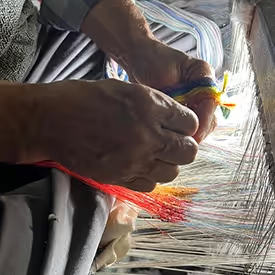
Today, however, traditional weaving faces enormous pressure from industrial textile production and fast-fashion systems that prioritize speed and volume over durability and environmental responsibility.
Hand weaving represents a different philosophy. Instead of mass output, it emphasizes skill, material knowledge, and longevity. A weaver must control thread tension, rhythm, and structure continuously, responding to the behaviour of the fibres with every movement of the loom.
These decisions cannot be automated easily, and they cannot be replaced by artificial intelligence. The quality of a woven textile depends on human judgment developed through years of practice.
At a time when the environmental cost of disposable clothing is becoming impossible to ignore, traditional weaving offers a reminder that textiles can be made slowly, carefully, and to last for generations.

Across many cultures, weaving has been passed from generation to generation, preserving both practical knowledge and artistic traditions. Techniques, patterns, and materials often reflect the history of a region and the skill of the weavers who practice the craft.
In Türkiye, the number of traditional shuttle looms has declined dramatically over the past several decades. Until the late twentieth century, weaving was still practiced in many homes, where women played a central role in the craft. They were the teachers of the tradition, passing down the knowledge required to prepare the loom, manage the warp, and control the rhythm of weaving.
As factory-made textiles became widely available in the 1980s, household weaving rapidly disappeared. When the looms left the homes, the women who had been the primary teachers of the craft also left the trade. In a single generation, the transmission of knowledge that had sustained weaving for centuries was largely broken.
Commercial weaving workshops continued for a time, but many struggled to compete with industrial textile production. By the summer of 2009, most of the traditional weaving workshops had gone bankrupt, leaving only a small number of male master weavers, the last generation trained before the earlier loss of the women teachers, still working on shuttle looms today.
If you would like a deeper look at how weaving works on traditional looms, including the tools, techniques, and physical skill involved, you can read our more detailed guide:
What Is Weaving: A Beginner’s Guide
That article explores the structure of the loom, the history of weaving, and why traditional textile craftsmanship continues to matter today.
To see what this craft actually produces, explore our handwoven thick-looped towels, or visit Jennifer's Hamam in Istanbul to see and feel them in person.